Local Search Ranking Factors: What Really Decides Who Shows Up on Google Maps
Google names three things: relevance, distance and prominence. Experts break those into 187 factors. Here is which ones move your map rankings, which ones hurt, and which are a waste of your week.
Written by Bharat BaghelSenior WriterBharat BaghelSenior Writer · Google Business Profile & local SEOSEO Manager with 4+ years of SEO inside software companies, including ControlHippo and SoftwareSuggest. Writes our Google Business Profile, local SEO and website guides.Read full bio →LinkedInEdited by BuzzTech Labs Editorial TeamEditorBuzzTech Labs Editorial TeamEditor · Local SEO researchChecks every BuzzTech Labs guide against Google's own help pages and policies before it goes live.Read full bio →Contact us11 min read
Google ranks local businesses on three things: relevance (how well your profile matches the search), distance (how far you are from the searcher) and prominence (how well known and well reviewed you are). Inside those three, local search experts rank your primary Google Business Profile category, your distance from the searcher, the words in your business name, having an address in the city being searched, and being open at the time of the search as the five strongest map ranking factors. Reviews, ratings and links fill most of the rest of the top ten. This guide shows what each factor means, which ones you control, and which popular tactics barely matter.
What Google itself says decides local rankings
Google confirms only the three big buckets, not a list of weights. Everything else you read about ranking factors, including this guide, is built on testing and expert opinion inside those buckets.
On its help page about improving your local ranking, Google says local results are mainly based on relevance, distance and prominence. It adds a few details that are worth knowing word for word:
"Businesses with complete and accurate info are more likely to show up in local search results."
If a customer doesn't share where they are, "Google uses what it knows about their location."
Prominence is "based on info like how many websites link to your business and how many reviews you have."
"More reviews and positive ratings can help your business's local ranking."
"There's no way to request or pay for a better local ranking on Google."
You controlRelevanceDoes your profile match the search?
Primary and extra categories
Services and description
Business name (real name only)
Website pages per service
You can't move itDistanceHow close are you to the searcher?
Where the searcher stands
A place named in the search
Your address or service area
Correct map pin
You build itProminenceHow well known are you?
Number of Google reviews
Star rating
Links from other websites
Mentions across the web
Illustration. The three buckets are Google's. The examples inside them are ours, based on Google's help pages and the expert survey below.
The 10 factors experts rank highest for Google Maps
The best public estimate of what matters inside Google's three buckets is Whitespark's Local Search Ranking Factors survey. The 2026 edition, published in November 2025, asked 47 local search experts to score 187 factors. Here are their top ten for map rankings, with what each one means for you.
#
Factor (survey wording)
Bucket
What to do about it
1
Primary GBP category
Relevance
Pick the most specific category that describes your whole business. See our category list for 32 industries.
2
Proximity of address to the point of search
Distance
You can't change it. Measure it with a rank grid and win nearby searches first.
3
Keywords in GBP business title
Relevance
Use your real name only. Adding keywords breaks Google's rules (see below).
4
Physical address in city of search
Distance
Make sure your address is correct and complete. Never use a fake or virtual office.
5
Business is open at time of search
Relevance
Set correct regular, holiday and special hours. Accurate hours beat long hours you can't keep.
6
High numerical Google ratings (4-5)
Prominence
Ask every happy customer for a review, and fix the problems behind bad ones.
7
Address showing on GBP (not a service-area business)
Distance
Show your address only if customers visit you there. Google's rules require this.
8
Additional GBP categories
Relevance
Add a few that are also true for your whole business. Skip the ones that aren't.
9
Quantity of native Google reviews (with text)
Prominence
Build a steady habit of asking. Reviews with written text count for more than star-only ones.
10
Proper placement of the map pin
Distance
Open your profile on Maps and check the pin sits on your actual door, not the middle of the block.
Two things stand out. First, half of the top ten are things you can fix in an afternoon: categories, hours, address and pin. Second, distance shows up four times. That's why two honest businesses with similar profiles can rank very differently a mile apart.
Keywords in the name work, and they're against the rules. Experts rank them third, which is why you see names like "Best Dentist Pune | Implants & Braces". Google's guidelines for representing your business say your name should match your real-world name and that adding unnecessary information isn't permitted. A stuffed name can be edited by Google, reported by a competitor, or lead to suspension. If your real, legal name happens to include a service word, like "Northside Plumbing", that's fine.
Relevance: telling Google exactly what you are
Relevance is the bucket you control most. It's about whether your profile and website clearly match the words people search.
Start with the category, because both the primary and additional categories made the top ten, and an incorrect primary category was rated the number two negative factor in the same survey. Then fill in every part of the profile with real detail:
Services. List each service by the name customers use: "root canal treatment", "drain cleaning", "bridal makeup". Add the local terms people type, like "AC service" or "packers and movers".
Description. Two or three plain sentences on what you do, who you serve and where. No keyword lists.
Hours. "Open at time of search" is a top-five factor. Wrong holiday hours cost you the searches you'd most like to win.
Your website. A clear page for each main service gives Google more to match. Experts also rated "dedicated page for each service" as one of the top ten factors that make people choose you.
Distance is based on where the searcher is, so your ranking is different on every street. You can't change it, but you can stop misreading it.
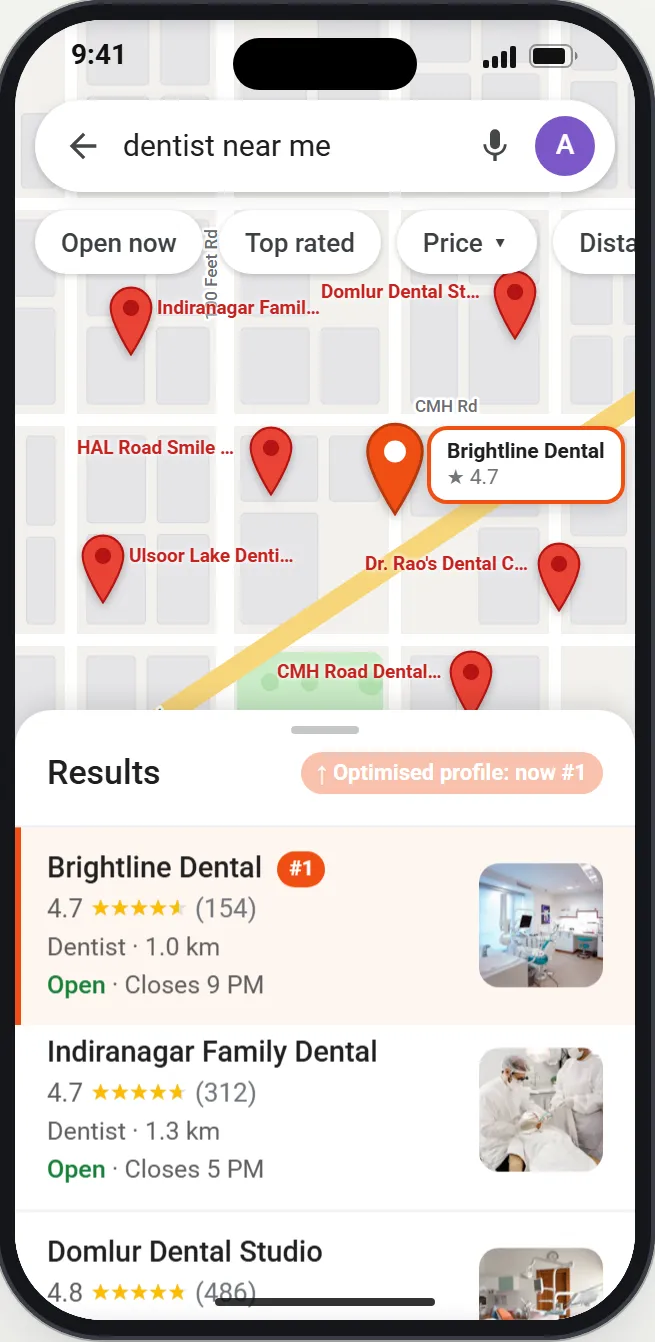
When an owner searches "dentist near me" from the front desk and sees their clinic first, they think they rank first. A patient two kilometers away sees a different list. That's why one phone search tells you almost nothing about your real position.
From our dental industry page. The results list shows the distance next to each clinic, and that distance changes with every searcher.
A rank grid fixes this. It checks your position for one keyword from a grid of points around your business, so you can see where you're strong and where you fade out. Here's a weak profile on a 25-point grid, next to the same profile after the work:
We search "dentist near me" from 25 spots around your business. Each dot shows where you rank from that spot.
BeforeWeak profile
1817191618171112131916127111718111212161918171817
0 of 25 spots in the top 3
→ profile work →
AfterSame clinic
4443442234321244222344444
12 of 25 spots in the top 3
1-3: in the top 3 on Google Maps, where most calls come from
4-10: on the list, but people must scroll
11+: hardly anyone sees you
Illustrative simulation, not a client result. Real gains depend on your location and how strong nearby competitors are.
The right side is the same simulated clinic after the profile work in this guide. Distance didn't change. The clinic just became the most relevant and prominent choice across more of the area.
Two distance rules matter for service-area businesses like plumbers, cleaners and movers. Google's service-area help page says to remove your address if you don't serve customers there, and keeps your service areas within about two hours of driving from your base, with up to 20 areas. Experts rank a visible address higher, but faking one to get it is exactly what gets profiles suspended. You can check your own position with our guide on how to check your Google Maps ranking, or let us run it with local rank tracking.
Prominence: reviews, links and your name around the web
Prominence is how well known Google thinks you are. Reviews are the part most businesses can grow fastest, and links and mentions build it slowly underneath.
Reviews
Google confirms that more reviews and positive ratings can help your ranking, and the experts put star rating and review count in their top ten. The detail that matters is how reviews arrive. "Sustained influx of reviews over time (rather than bursts)" scored well, while "receiving too many Google reviews too fast" appears on the negative list. Ten reviews a month for a year looks natural. Two hundred in a week looks bought.
Reply to reviews too. "No owner responses to any reviews" is on the experts' negative list, and Google itself lists responding to reviews as a way to improve your local presence. Never buy reviews, pay for them or only ask happy customers. Google's policy on prohibited content bans fake engagement, and our guide on whether Google can detect fake reviews explains how those reviews get caught.
Links and mentions
Google says prominence is partly based on how many websites link to your business. For a local business, the useful links are local and real: your city's chamber of commerce, a local news story, a supplier's "where to buy" page, an association you belong to. Consistent listings in directories help Google trust your name, address and phone. Depending on where you work, that can mean Yelp, JustDial, Sulekha, Healthgrades or Practo for clinics, and your trade association.
Factors that push you down
Some factors work against you. The survey's negative list is short, and most of it is avoidable.
Negative factor (survey rank)
How it usually happens
The fix
Business marked as permanently closed (#1)
A false "closed" edit from a user or competitor goes through
Check your profile weekly and dispute wrong edits fast
Incorrect primary category (#2)
A broad or wrong category picked during setup
Pick the most specific true category
Low numerical ratings, 1-2 stars (#4)
Real service problems, or no review habit so a few angry reviews dominate
Fix the cause, reply calmly, and ask every happy customer
No crawlable address and phone on your website (#10)
Contact details only inside an image, or missing
Put your name, address and phone as real text on the site
Too many Google reviews too fast (#30)
A review drive or bought reviews
Ask steadily after every job instead
No owner responses to any reviews (#36)
Nobody owns review replies
Reply to every review within a couple of days
Number one is worth a closer look. Anyone can suggest edits to a business on Google Maps, and a "permanently closed" label can wipe out your calls overnight. Monitoring for unwanted edits is part of our Google Maps SEO work for that reason.
Popular tactics that barely move rankings
A lot of local SEO advice spends your time on things the experts rate close to zero for rankings. Some still help customers. They just won't lift your position.
Geo-tagged photos. The survey's number one myth. Adding location data to photo files doesn't help. Real, recent photos do help people choose you.
Posting more often. Post frequency and quantity sit near the bottom of the ranking list. Posts still show offers and news to people looking at your profile, so post for them, not for the algorithm.
Social media followers. Rated the number two myth for map rankings.
Buying Google Ads. Paying for ads doesn't change your free ranking. Google says you can't pay for local ranking, and experts rated it the number three myth.
Keywords in review replies. Stuffing "best dentist in Austin" into every reply doesn't help, and it reads badly to the next customer.
The local ranking factor cheat sheet
Here's every factor in this guide on one page: what it is, how sure we are it matters, and the one thing to do about it. Save it, print it or share it with whoever manages your profile.
Factor
Bucket
Evidence
Your move
Primary category
Relevance
Google says categories affect ranking; experts rank it #1
Most specific true category
Additional categories
Relevance
Experts #8
A few true extras, not nine
Business name
Relevance
Experts #3; keyword stuffing is against Google's rules
Real-world name only
Open at time of search
Relevance
Experts #5
Correct regular and holiday hours
Complete, accurate profile
Relevance
Google confirms
Fill in services, description, attributes
Page for each service on your site
Relevance
Experts' top ten for getting chosen
One clear page per main service
Distance to searcher
Distance
Google confirms; experts #2
Measure with a rank grid
Address in the searched city
Distance
Experts #4
Correct, real address only
Visible address (not service-area)
Distance
Experts #7
Show it only if customers visit
Map pin placement
Distance
Experts #10
Check the pin is on your door
Star rating
Prominence
Google confirms; experts #6
Fix problems, ask every customer
Number of reviews with text
Prominence
Google confirms; experts #9
Steady requests after every job
Review replies
Prominence
Google recommends; no replies is a negative
Reply to every review
Links to your website
Prominence
Google confirms
Earn real local links
Directory listings
Prominence
Widely used by local SEOs; not confirmed by Google
Same name, address, phone everywhere
Posts, geo-tagged photos, social followers, ads
None
Experts rate close to zero for rankings
Do them for customers, or skip them
Ranking first is only half the job
Ranking gets you seen. Your reviews, photos and website decide whether people tap you or the next result.
The same survey has a separate list for what makes people choose a business, and it looks different. High ratings, positive words in reviews, a mobile-friendly website, recent reviews and correct hours all score near the top. That's why a clinic at number two with 300 fresh reviews and a fast site can get more calls than the clinic at number one. If your website is slow or hard to use on a phone, start with our website design service.
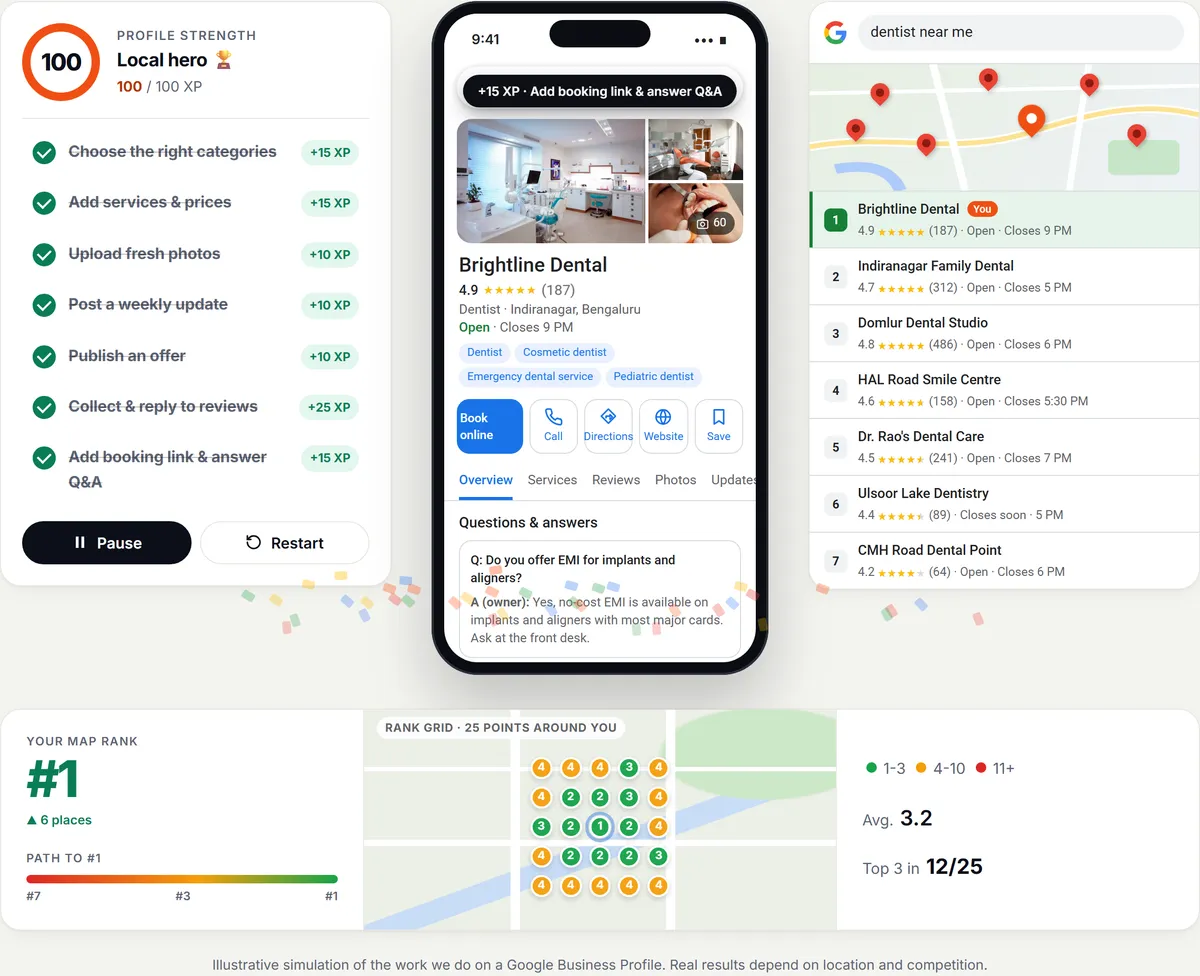
Our profile simulator after every task is done. Illustrative only: it shows the factors we work on, not a promised result.
What to do this week
Work through the factors in order of effort, cheapest first. Most businesses can finish the first four in one sitting.
Check your primary category against the top three businesses for your main search.
Fix your hours, including the next holiday, and check your map pin.
Clean up your name if it has anything your sign doesn't.
Fill in every service and write a plain description.
Start a review habit: a request after every job, by text or WhatsApp, and a reply to every review. Our review management service can run this for you.
Run a rank grid so you know your real starting point, then check again in 90 days.
For the full step-by-step plan, read how to rank higher on Google Maps. If you'd rather hand it off, we handle all of this on a monthly plan. Plans are month-to-month after the first three months, and you can see what's included on our plans page. Tell us about your business and we'll reply with a quote within one working day.
Google Maps & Local SEO questions, answered
What are the three main local search ranking factors?
Google names three: relevance, distance and prominence. Relevance is how well your profile matches the search. Distance is how far you are from the person searching. Prominence is how well known your business is, based on things like reviews and links from other websites. Every other factor fits under one of these three.
What is the most important ranking factor for local SEO?
In Whitespark's 2026 survey of local search experts, the primary Google Business Profile category ranked first for map rankings, with the searcher's distance from the business a very close second. You control the category, so it's the best place to start. You can't move distance, but you can measure it.
Do Google posts help local rankings?
Not much, according to experts. Post frequency and quantity sit near the bottom of the 2026 ranking factor list. Posts still help in another way: they keep the profile fresh and give people a reason to call. Post because it helps customers choose you, not because you expect a ranking jump.
Do reviews affect local search rankings?
Yes. Google says more reviews and positive ratings can help your local ranking. Experts put high star ratings and the number of Google reviews with text in their top ten. A steady flow of reviews over time looks better than a sudden burst, which experts rate as a negative signal.
Can you pay Google for a higher local ranking?
No. Google states there is no way to request or pay for a better local ranking. Ads and Local Services Ads appear in separate, labeled spots. Experts in the 2026 survey also rated taking part in Google's paid products as close to no effect on your free map ranking.
Why does my Google Maps ranking change from place to place?
Because distance is part of every local search. Google ranks results for where the searcher is, so you can be first a few streets from your door and tenth across town. A rank grid checks your position from many points around your business and shows the real picture.
How long do local SEO changes take to work?
Fixes like a better primary category or correct hours can show up within days or a few weeks. Prominence signals, such as reviews and links, build slowly. Plan on about three months of steady work before you judge results, and longer in busy areas with strong competitors.
Senior Writer · Google Business Profile & local SEO
Bharat Baghel is an SEO Manager with 4+ years of SEO and marketing inside software companies. He led SEO and content for the ControlHippo blog and spent close to three years on SEO at SoftwareSuggest, building pages at scale. At BuzzTech Labs he writes about Google Business Profile, local SEO and websites, and what actually brings a local business more calls.
Edited by the BuzzTech Labs editorial team before publishing. We only cite what we can verify.
Google ranks local businesses on relevance, distance and prominence. Here is what each one means in practice, what to fix first, and a 90-day plan for dentists, clinics and makeup artists.
A plain-English walkthrough of every field that matters on your Google Business Profile, in the order we set them up, plus the weekly routine that keeps a profile ranking.
· 16 min read
The BuzzTech Labs Brief
Local growth notes, once a week.
One practical email on Google Maps, reviews and websites for local businesses. No spam, unsubscribe any time.